
Drone Strike Triggers Fire Near UAE’s Barakah Nuclear Power Plant Amid Rising Gulf Tensions
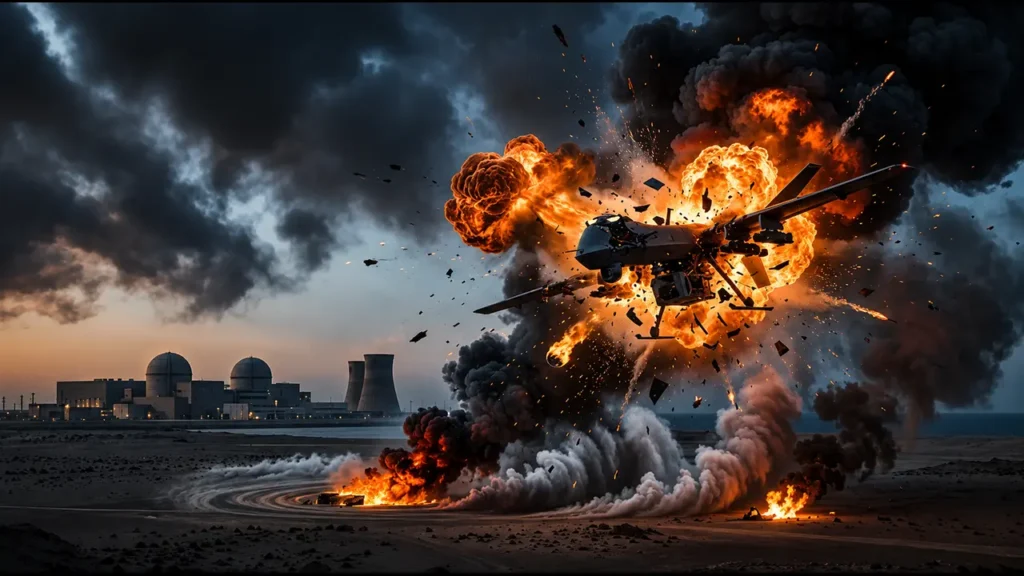
A drone strike near the Barakah Nuclear Power Plant in the United Arab Emirates has heightened fears of a wider regional escalation as tensions continue to rise across the Middle East.
Officials in Abu Dhabi confirmed that a fire broke out on Sunday at an electrical generator located outside the inner security perimeter of the Barakah Nuclear Energy Plant in the Al Dhafra region. Emergency teams quickly responded to the incident, and authorities said the blaze was contained without injuries or radiation leaks.
The UAE’s nuclear regulator reassured the public that the country’s nuclear operations were not affected by the strike. Officials stated that all reactor units continued functioning normally and that radiation levels remained within safe limits.
The Barakah facility is the first nuclear power station on the Arabian Peninsula and is considered one of the UAE’s most strategically important infrastructure projects.
UAE Says Drones Entered From Western Direction
Later on Sunday, the UAE Ministry of Defence announced that the country’s air defence systems intercepted two drones before they reached their intended targets. However, a third drone reportedly struck a generator near the plant perimeter, causing the fire.
Authorities said the drones entered Emirati airspace from the western border direction but did not provide additional details regarding the origin of the attack. Investigations remain ongoing to determine who was responsible.
The UAE has not officially blamed any country for the incident, and no armed group immediately claimed responsibility.
Regional governments, including Saudi Arabia and Qatar, strongly condemned the attack and described it as a dangerous threat to Gulf security and stability.
Nuclear Safety Concerns Raised
The International Atomic Energy Agency expressed concern following the strike and confirmed that one reactor at the Barakah plant temporarily relied on emergency diesel generators after the electrical disruption.
IAEA Director General Rafael Grossi described military activity near nuclear facilities as “unacceptable” and warned that attacks involving critical infrastructure could create severe risks for civilians and the environment.
Despite the temporary power disruption, officials emphasized that nuclear safety systems remained operational throughout the incident.
The Barakah Nuclear Power Plant is located approximately 225 kilometers west of Abu Dhabi and near the Saudi Arabian border, making it strategically significant within the Gulf region.
Rising Tensions Between Iran, US, Israel, and Gulf States
The drone strike occurred amid continuing tensions involving Iran, the United States, Israel, and Gulf countries following months of military confrontations and diplomatic deadlock.
The UAE has faced repeated missile and drone threats since the conflict between Iran and the US-Israel alliance intensified earlier this year. Although a ceasefire agreement was announced in April, attacks and regional security incidents have continued.
Disputes over Iran’s nuclear program, sanctions, and the Strait of Hormuz remain unresolved, increasing fears that the fragile truce could collapse entirely.
US President Donald Trump renewed pressure on Tehran following the latest incident, warning Iran in a social media post that time was running out to reach an agreement with Washington.
“For Iran, the clock is ticking,” Trump wrote, warning that Tehran needed to move quickly toward a deal.
Iranian military officials responded sharply to the remarks. Senior armed forces spokesperson Abolfazl Shekarchi warned that if American threats were carried out, the United States would face “aggressive and surprise scenarios” in the region.
Strait of Hormuz Crisis Continues
The broader regional crisis has also disrupted shipping and oil exports around the Strait of Hormuz, one of the world’s most important energy transit routes.
Iran has repeatedly warned that countries hosting US military forces or supporting Israeli operations could become targets during the ongoing confrontation.
Energy markets remain nervous as instability around Gulf shipping lanes continues to push oil prices higher and raise concerns over global supply chains.
Analysts say attacks near nuclear and energy infrastructure could further increase tensions and deepen economic uncertainty across international markets.
UAE-Iran Relations Under Strain
Relations between Tehran and Abu Dhabi have deteriorated significantly in recent months.
Last week, Emirati officials accused Iran of launching missile and drone attacks against the port city of Fujairah, where a fire reportedly broke out at an oil facility. Several foreign nationals were injured during that incident.
Iran has also accused the UAE of strengthening security ties with Israel during the conflict. Reports circulating in regional media claimed Israeli Prime Minister Benjamin Netanyahu made a secret visit to the UAE during the ongoing crisis, though Emirati officials denied the claims.
US Ambassador to Israel Mike Huckabee recently stated that Israel had deployed Iron Dome air defence systems and military personnel to the UAE to help defend against potential Iranian attacks.
The UAE Foreign Ministry has strongly rejected what it described as Iranian attempts to justify attacks on Emirati territory. Officials stated that the country reserves the right to respond to threats against its sovereignty and national security.
Fear of Wider Regional Conflict Grows
Diplomatic efforts continue behind the scenes as regional and international powers attempt to prevent the crisis from expanding into a larger war across the Middle East.
However, ongoing drone attacks, military deployments, threats, and disruptions to global energy routes have raised fears that the situation could rapidly deteriorate if negotiations fail.
Security analysts warn that continued attacks involving nuclear facilities or major oil infrastructure could trigger severe geopolitical and economic consequences far beyond the Gulf region.
For now, Gulf nations remain on high alert as uncertainty surrounding Iran, Israel, and the United States continues to dominate regional security concerns.